
Despite the challenging commercial environment affecting both public and private sector broadcasters, demand for new specialist cameras remains relatively buoyant in sports and selected entertainment verticals such as live music.
With a long and distinguished history of providing specialist cameras and customised solutions to sports broadcasters, Camera Corps is well-positioned to chart the current and long-term trajectories of demand. Commercial manager Barry Parker acknowledges the challenges facing broadcasters at present but is also upbeat about their continuing interest in innovative new specialist cameras.
“The industry is focused on developing higher quality, more efficient, faster-to-rig, more sustainable solutions at cost-effective price points,” he says. “Continuous innovation drives improvements in sensor technology, frame rates, power efficiency, physical size and low-light capabilities of specialist cameras.”
Among the emerging trends, he cites the rise of AI-driven automation for tasks such as player tracking and auto-adjustment of camera settings; higher resolution cameras allowing for enhanced cropping and re-framing; sustainability prioritisation regarding camera production, lifespan and disposal; and new solutions that are customer-driven so they align fully with user needs.
Parker also indicates that there is a broader emphasis on operational context these days, for instance at large sports events where real estate is limited. “Something that is considered more of a longer-term objective here is to integrate broadcast, officiating cameras, and augmented reality systems for live content capture and analysis into one system. Although this is not always possible due to rights, formats and schedules.”
“While general spending is tight, targeted investments in technologies that demonstrably cut costs or increase revenue are still a high priority”
In terms of specific camera types that are most in-demand, it will not come as a surprise to discover that the rollcall includes compact PTZs. “Despite widespread need, it seems the broadcast rental industry simply doesn’t have enough supply during peak periods, and this becomes a balancing act for suppliers in this market, along with managing the lifespan of a camera in the environments they are used,” he adds.
There is also a consistent level of interest in high-frame-rate mini-cameras, suitable for field of play immersive shots and VAR-style review applications, as well as weatherproofed and submersible cameras for aquatics and other “extreme condition” sports. Parker says: “Our suite of underwater cameras, both tracking and PTZ, are now upgraded to 4K, enhancing visibility in professional swimming events and other challenging environments.”
Fresh production techniques and increased coverage of more niche sports is also contributing to added requests for customised solutions. “As an example, we recently developed a camera embedded in the wall hand hold for speed climbing. Our client needed an innovative, integrated camera that fitted their budget. These bespoke requests highlight how we not only refresh technology and ideas, but actively engineer solutions tailored to specific sports,” says Parker.
Content from new perspectives
Benoit Dentan, founder and CEO of aerial filming and multi-dimensional tracking solutions company XD Motion, also references the need for camera solutions supportive of AR applications. “For AR to be effective, virtual graphics must be perfectly synchronised with the real-world action, which requires high-quality camera tracking data. This transforms the camera from a simple imaging device into a precision data-gathering tool, capturing position, orientation, and lens information.”
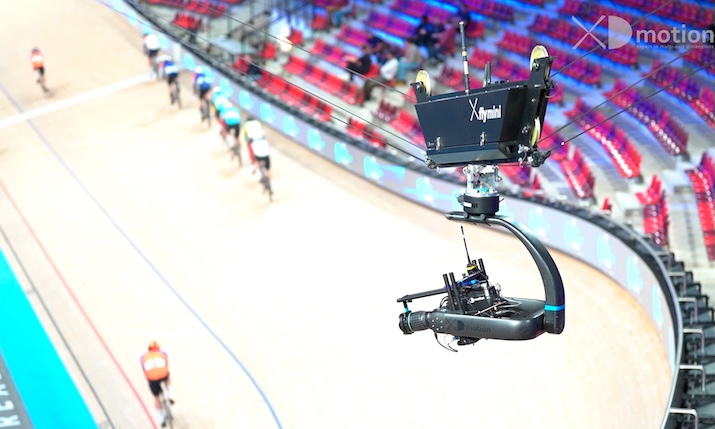
This requirement has informed the development of XD Motion solutions such as the high-speed cablecam X fly 1D mini. Dentan says: “Its true innovation lies in combining breathtaking speed with perfectly stable, mechanically tracked data. This is crucial for making live AR graphics appear seamlessly integrated with the on-screen action. We successfully deployed this system for the UCI Track Champions League, delivering spectacular live AR shots over RF and 5G, bringing viewers closer to the intensity of the race than ever before.”
Control and automation of complex production environments is another market priority – something XD Motion has responded to with its IO.BOT software, which allows a single operator to control and automate a fleet of up to 16 different robotic systems – “from PTZ and robotic arms to dollies and track”, notes Dentan.
Surveying the market more generally, he says that there is a “surging demand for content from new perspectives. Aerial and robotic systems such as drones, cablecams and robotic arms are capturing breathtaking shots once considered impossible, bringing viewers closer to the action”. And despite economic pressures, broadcasters remain willing to invest in solutions that increase efficiency, boost viewer engagement and/or generate new revenue: “In short, while general spending is tight, targeted investments in technologies that demonstrably cut costs or increase revenue are still a high priority,” he adds.
A space that’s still evolving
Camera solutions specialist Batcam is also in the happy place of finding that demand is robust despite broader industry fluctuations. “The challenge has always been around resources rather than sales, and so we’re lucky that we’re still growing – as we have done for the past 12 years,” says CEO and co-founder Jon Hurndall. “For instance, our first major product was a kind of UAV [unmanned aerial vehicle] system, and the use of those has continued to grow over time, while the regulations around them have changed and become less restrictive. That’s allowed us to create new use cases and opportunities for broadcasters, as a result of which we’re in a space that’s still evolving.”

Jon Hurndall, Batcam
Recent developments include a new, small and sub-250g aerial camera, BabyBAT, which was first used in the UK by Prime to capture footage during the Liverpool vs PSG UEFA Champions League match in April. The development of this product underlines observations elsewhere in this article about a trend towards lighter, more compact systems; more generally, Hurndall indicates that Batcam’s R&D tends to be driven by recognition of new creative opportunities – and then providing the technology with which they can be realised.
“If we have an idea of a new way to get a shot, or a new piece of technology that allows a certain thing that’s not been done before, we’ll carefully consider how it could be used and if we think there’s a market for it. Then the next step will be to go the sport directly and say, ‘we’ve got this idea, what do you think, and is there an interest in us developing it?’”
With which observation, Hurndall neatly underlines the very close connection that exists between specialist camera and sports broadcasters – one that has ensured the sector remains buoyant even when some others might be faring less well.
link