
What you will learn:
- The limitations of traditional Bayer color filters, which block significant amounts of light, limiting image quality.
- About a new photonics-based color splitting technology, which uses vertical waveguides to improve light sensitivity, resolution, and color accuracy by guiding rather than filtering light.
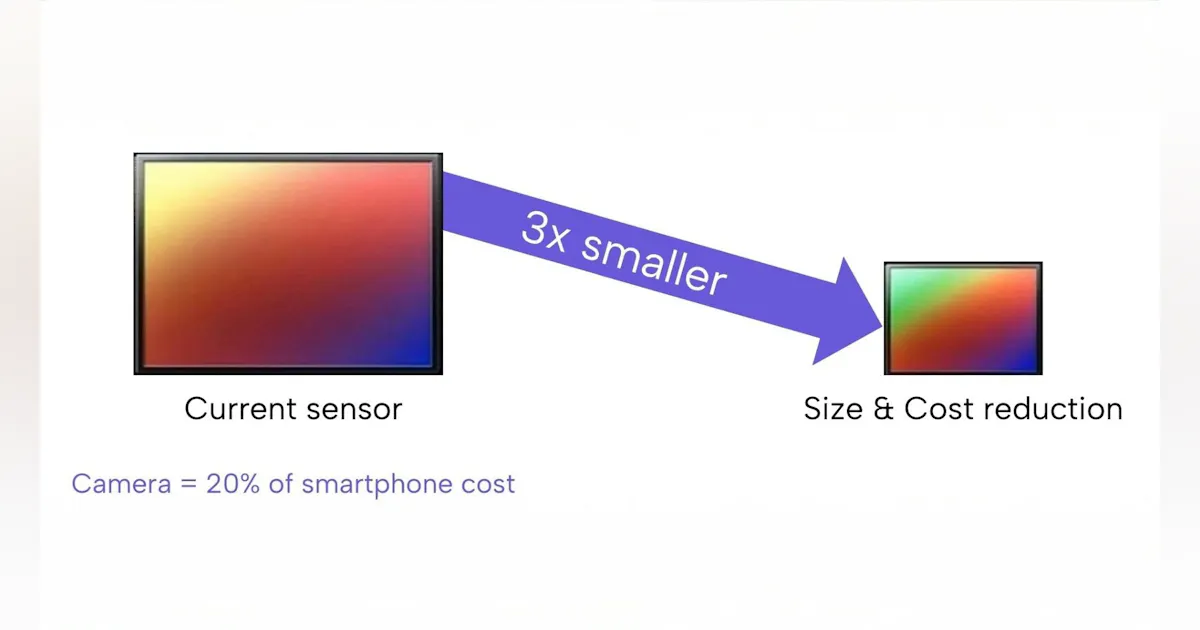
- How this technology could enable smaller, cheaper image sensors with more accurate color resolution.
The quest for higher quality imaging has driven continuous innovation in camera technology. However, fundamental limitations in current technologies pose challenges to further advancements. Leveraging the power and efficiency of photonics, a new solution that uses a waveguide-enabled color splitting technique can overcome the limitations of traditional color filters. New products coming to market using this approach show promise for reducing cost and size while increasing performance.
Current Limitations of Bayer Color Filters
Currently the most prevalent technology used to produce color imagery in image sensors today is the Bayer filter. This color filter array (CFA) uses a grid of red, green, and blue filters arranged in a specific pattern. While effective, Bayer filters inherently sacrifice efficiency and introduce limitations:
- Inefficiency: Color filters absorb a substantial amount of light. In fact, up to 70% of the incoming light is blocked, severely limiting the amount of light available to the sensor. This necessitates larger pixels and sensors to capture sufficient light, leading to larger, bulkier camera modules, especially in applications like smartphones.
- Resolution Limits: Bayer filters also impose a limit on image resolution. Since each pixel only captures one color component, the missing color information must be interpolated from neighboring pixels. This interpolation process can blur fine details and reduce overall sharpness.
- Color Artifacts: The interpolation process used with Bayer filters can also introduce color artifacts, such as moiré patterns and false colors, which degrade image quality.
- Scaling Challenges: As CMOS image sensor (CIS) technology advances and pixel sizes shrink, Bayer filters present scaling challenges. The need for color filters limits the ability to create sufficiently small pixels to achieve ultra-compact, high-resolution imaging.
The Smartphone Dilemma
The mobile/smartphone market represents the largest segment for CMOS image sensors, and it demonstrates the problem with current light gathering techniques.
Related: CMOS Sensors: Graphene and Quantum Dots Combine for Broadband CMOS Camera
With each successive generation of device, phone makers seek to improve the quality of the cameras in the device, largely because it has become the number one purchasing criteria consumers use to decide on a new model phone. While improvements in image quality have been steady, they come at a cost—literally, in terms of the price of the increased-sized sensors. But as importantly, this also impacts the physical size needed to house these cameras, which have knock-on effects in terms of cost, not to mention consumer’s desire for more compact phones. Challenged by the fact that the only approach to addressing the color limitations of inefficient light collection has been to increase the size of the sensors, phone makers have consistently made bigger, more expensive devices to drive camera improvements forward.
Related: Dual-Band Filters Target Price-Sensitive Applications
Vision-enabled systems in other application areas face similar challenges.
link